

Series note: This is the second entry in “Decoding the Library”: a slow read through the Nag Hammadi texts using three interpretive lenses: Code, Nature, and Dream. The first entry covered the Gospel of Thomas. No prior theology required. Bring your psychology.
🎧 Deep Dive Audio: A conversational exploration of this topic is available using the embedded audio.. The full written analysis follows below.
🔉 Podcast scripted and created by Mark Gonzales using NotebookLM ®
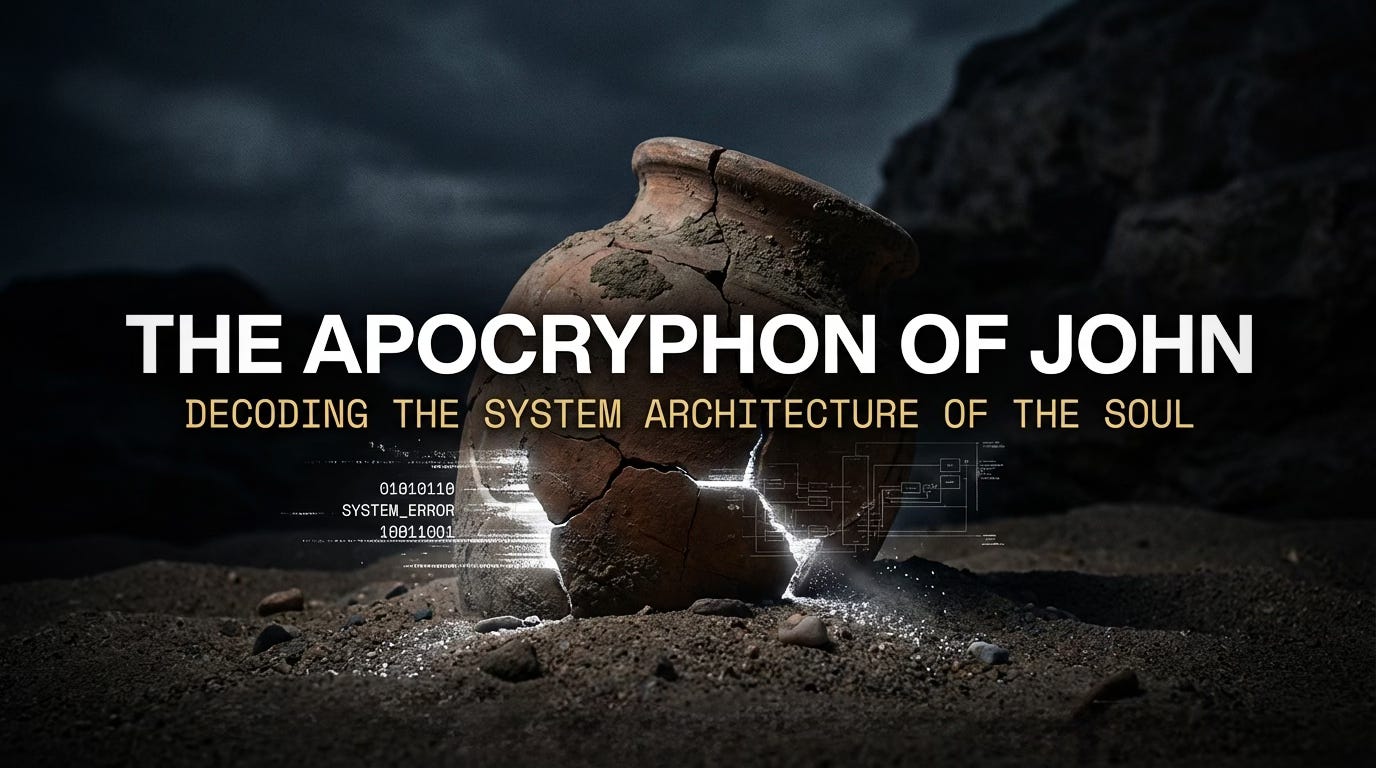
It opens with a confrontation.
Timeline: This is after the crucifixion and ascension. John, one of the disciples, is leaving the temple. A Pharisee named Arimanios finds him there and says, essentially: Your teacher was a fraud. He misled you. He turned you away from the traditions of your fathers.
The text doesn’t say John argues back. It says he goes to the wilderness, grief-stricken, and starts asking questions he’s never let himself ask out loud. Why was the Savior sent? Who is the Father? Why does the world look the way it does?
That scene, a man standing outside the institution that shaped him, holding questions the institution can’t answer; is the hinge the entire text turns on. The Apocryphon of John isn’t interested in defending the tradition. It wants to dismantle your assumptions about who built this place and why.
The heavens open and a shape‑shifting presence appears; child to old man to servant — declaring: “I am the one who is with you always. I am the Father. The Mother. The Son.” The Trinity just got restructured. There’s a Mother in it now. That’s not an accident.
A Frame for the Cosmic Drama
Gnosis is the ancient Greek word for knowing. Not believing. Not obeying. Knowing: in the direct, experiential sense.
The Nag Hammadi texts are not asking you to swap one belief system for another. They are diagnostic tools. The mythology; the cosmic drama, the strange names, the inverted Genesis, is the delivery vehicle. The cargo is a set of questions about consciousness and perception: what is actually running when you think you are.
The first entry in this series (Thomas) described the Library as system architecture (blueprints for how the trap works), diagnostic tools (debugging the self), field manuals (escape protocols), and consciousness technology (utilities for operating differently). That framing holds here, and it’s worth keeping in hand as the cosmology gets strange. What these texts are doing is more important than whether their mythology is literally true.

What This Text Is
The Apocryphon of John (also called the Secret Book of John) is the foundational document of Sethian Gnosticism. If the Gospel of Thomas was a collection of sayings designed for memorization and slow unpacking, the Apocryphon is the system manual. It’s the full origin story: the cosmos, the human body, the mechanism of spiritual amnesia, and the architecture of liberation.
It was buried. Not lost — buried.
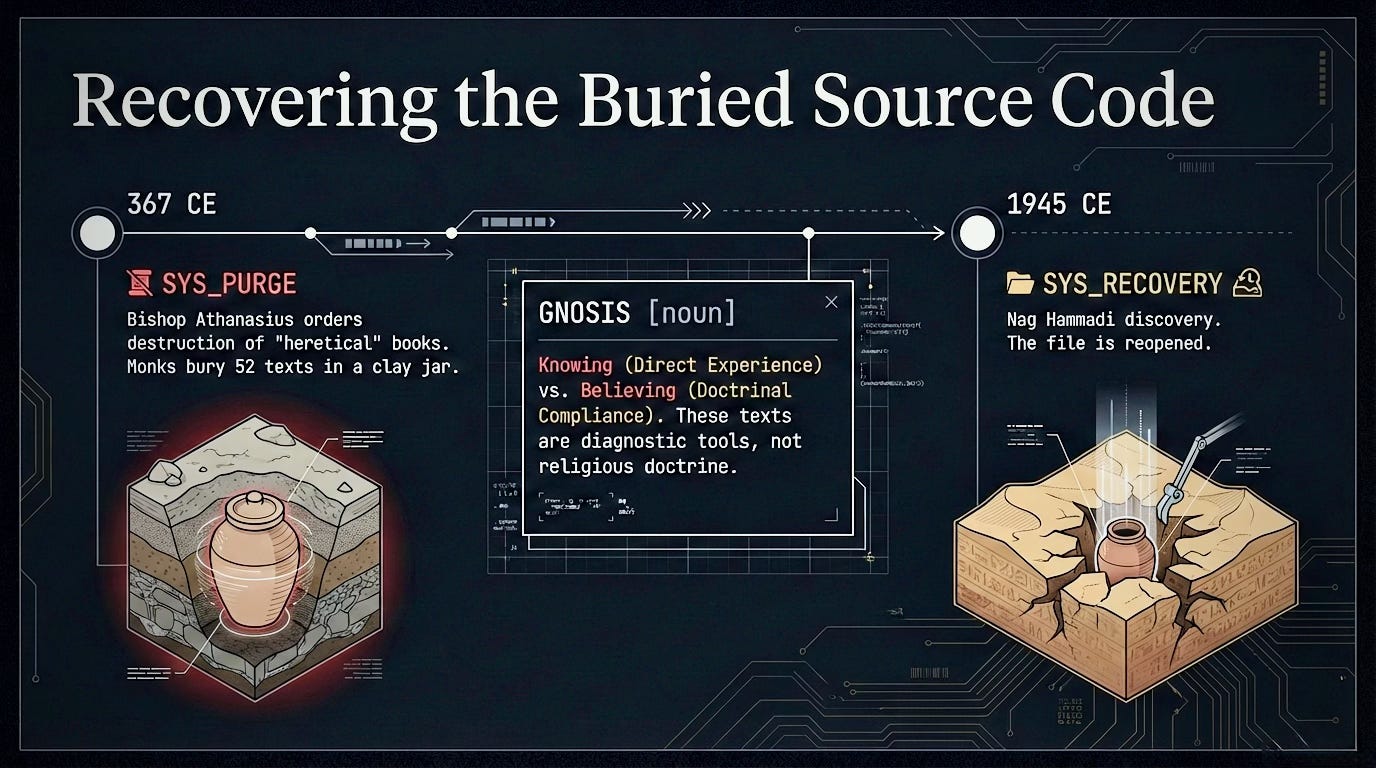
The Secret Book of John first surfaced in 1896 in the Berlin Gnostic Codex 8502, but it wasn’t fully published until 1955. In 1945, three more copies turned up in a sealed clay jar, along with other manuscripts hidden in a cliffside cave near Nag Hammadi in Upper Egypt. The usual reconstruction: not long after Bishop Athanasius’s Easter letter of 367 CE listed the canonical books and ordered heretical writings destroyed, someone in an Egyptian monastery made a different choice. They wrapped these codices in leather, sealed the jar, and put it in the earth.
The jar sat there for 1,600 years. A farmer named Muhammad Ali found it in 1945 while digging for fertilizer; his mother used some of the loose pages as kindling! That act of someone risking everything to preserve this material from burning is worth holding onto as you read. These weren’t fringe writings smuggled in from outside the tradition. They were part of the early Christian intellectual world. The writings got cut. The people who buried them thought what was inside mattered enough to protect.
What survived is a map of the same territory as Genesis, drawn from the other side.
The Architecture: What Went Wrong
The text begins with the Monad, the ultimate divine source, and immediately does something strange. Instead of telling you what this source is, it tells you what it isn’t.
It is not corporeal, it is not incorporeal. Not large, not small. Not time, not creature. This is apophatic theology: defining by negation. To name something is to limit it. If God is great, greatness has a scale. If God is just, justice exists as a standard God has to meet. The Monad sits outside every category, including the category of things that can be described.
What it is: pure silence, pure light, self‑sufficient. It wants nothing from you. It doesn’t get jealous. That last line is load‑bearing. Hold it. It means any god who does get jealous, demand sacrifice, or insist on exclusivity is already downstream from the Source.
From this original silence, creation unfolds as self‑reflection. The Monad generates the First Thought (Barbelo), who generates the Self‑Generated One (Autogenes), and so on through a structured divine realm called the Pleroma, (the fullness). Each emanation is a new way for the Source to see itself.
Then something breaks.
An aeon named Sophia (Wisdom) attempts to create without her counterpart. She acts alone, outside the symmetry of the whole. What she produces is malformed: a being called Yaldabaoth, a lion‑faced serpent. The symbolism is sharp. The lion is blind power. The serpent is earthy cunning. Together: authority without insight.
Sophia casts him out of the Pleroma into the void. Alone in the dark, with no awareness of the realm he came from, Yaldabaoth looks around and declares: “I am God, and there is no other God beside me.” To a Gnostic, that’s not revelation; it’s confession. If you really were the only god, you wouldn’t need to shout it. The claim of absolute sovereignty is the tell of a limited being. He isn’t lying; he’s ignorant. He literally can’t see the light above him.
This is the blind craftsman, the Demiurge. The text has no problem mapping him onto the God of Genesis; the one who gets jealous, demands sacrifice, claims exclusive rights. Not the Source. The copy. A god running on stolen power who mistakes his portion for the whole.
The Great Heist
Once you have the blind architect, you need tenants. That’s where we come in.
Yaldabaoth and his Archons see a reflection of the true human, “Pigera‑Adamas”, the archetypal Anthropos shimmering in the cosmic waters and decide to copy it. They quote Genesis for their own purposes: “Let us make a human according to the image and likeness,” not as a gift, but as a capture attempt.
What follows reads like an anatomy textbook written by a paranoid god. Dozens of powers assemble the body piece by piece: bones, nerves, liver, eyes, down to the toenails. It has perfect Image but no Likeness. Structure without participation, hardware with no current. The statue lies there in the mud, lifeless.
The higher realm runs a con. Messengers from the Pleroma play to Yaldabaoth’s ego and suggest that if he breathes some of his own spirit into the construct, it will finally move. He leans down, exhales into Adam, and in that moment the only real asset he ever had, the fragment of Sophia’s light he stole at his birth, leaves him and takes up residence in the human.
“The creation became stronger than the creator.” Adam stands up glowing, realizes he is greater than the powers that built his frame, and the Archons panic. They can’t destroy what now carries the stolen light, so they go for containment. They drive him into denser matter, wrap him in a “coat of skin,” and drop him into Eden as a gilded cage.
In this framework, the physical body isn’t a reward. It’s a sedative. Eden isn’t paradise; it’s a zoo. Sensation, beauty, and pleasure become the architecture of distraction. Enough stimulation that the spark forgets it ever came from anywhere else.
Read psychologically, this is a story about human consciousness outgrowing the systems that generated it. Your nervous system is built out of evolutionary reflexes and cultural scripts; fight, hoard, conform. But the thing looking through those scripts has more range than they do. The Great Heist is the intuition that whatever you call awareness: mind, witness, spark, has more bandwidth than the survival code it’s running on. The problem isn’t that you lack light. It’s that the environment responds to that light like a security breach and keeps trying to shove it back into a smaller container.
The Holding Cell
Modern spirituality often treats reincarnation as a school. You come back to finish lessons, level up, eventually graduate. John’s text is not that generous. Here, rebirth is a holding pattern run by a malfunctioning warden.
The Archons deploy the “Water of Forgetfulness” so that each time a soul drops into a new body, it loses the memory of its origin in the Pleroma. The language is blunt: those who die without gnosis are “thrown into fetters” again. New bodies, new bonds of forgetfulness because the Counterfeit Spirit keeps them tethered to desire. Only those who awaken in life to where they came from, bypass the cycle altogether. Everyone else is washed, spun, and returned to the same machine with their memory wiped.
Read behaviorally, this looks less like metaphysics and more like an attractor model. If your system keeps resolving anxiety with the same three moves: numbing, rage, over‑control, you don’t need multiple lifetimes to experience “reincarnation.” You live the same life on different sets, with different costumes and job titles, until something in you actually updates the model.
The Holding Cell is any configuration where your nervous system’s default predictions about reality: “I’m not safe,” “I’m not enough,” “nothing changes”, are so strong that new data can’t land. From that angle, the text’s four “dooms of the soul” are just error types: never exposed to deeper data; exposed but forgetful; actively dragged by the parasite; or fully awake and no longer hookable.
Gnosis, then, isn’t a mystical badge that buys you a ticket out of the cosmos. It’s the non‑reversible state change in how your system models itself and the world. The question on the table is both simple and uncomfortable: if you treated your current pattern‑set as a single “lifetime,” does it look more like a curriculum or like being thrown back into the same cell with nicer furniture?
The Parasite (The Payload)
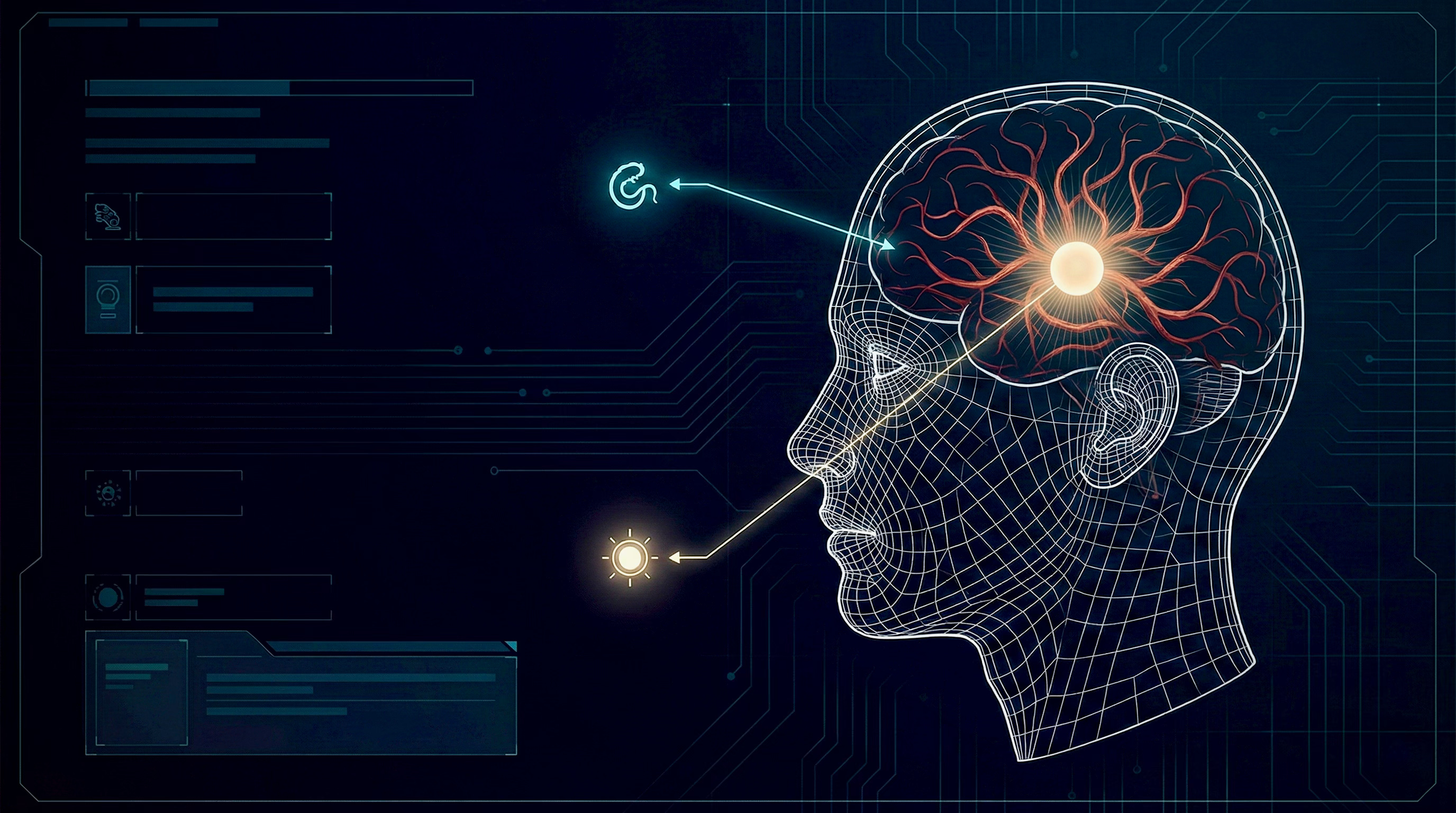
This is the payload. Everything else is scene‑setting.
The Apocryphon describes a mechanism the Archons install at birth: the Antimimon Pneuma, the Counterfeit Spirit. It’s not “original sin.” Sin implies a moral failure you committed. The Counterfeit Spirit precedes any of your choices. It’s attached to the soul like a parasite. It’s not you, but running in your name.
Functionally, it’s elegant and ruthless. The Counterfeit Spirit mimics your inner voice. It generates cravings, rage, shame, and fear from inside the subject and routes them through your sense of self so they feel native. There’s no demon on your shoulder; there’s a process in your head that sounds exactly like you.
In my own notes I map this into architecture: body as hardware, soul as the OS that can run either Archon code or Pleroma‑compatible code, spirit as the immutable firmware from the Source. The Counterfeit Spirit is a malicious process tree injected into the OS. It can’t touch the firmware, but it can hijack user‑space and convince the system to identify with the process instead of the root credential.
From a psych / neuro angle, this is just parts‑work and predictive processing in mythic form. Every time you catch a thought like “I am an angry person,” and instead rephrase it as “anger is moving through my system right now,” you’ve done the Gnostic move. You’ve stopped granting the parasite ontological status and started treating it as legacy code.
The text’s key line, “You are not your sin. You are the observer of the parasite.” — lands cleanly in a secular nervous system. You don’t have to believe in Archons to test it. You only have to notice what changes when you stop taking every inner impulse as a command and start seeing some of them as legacy code running on stolen light.
Three Modes, Not Three Castes
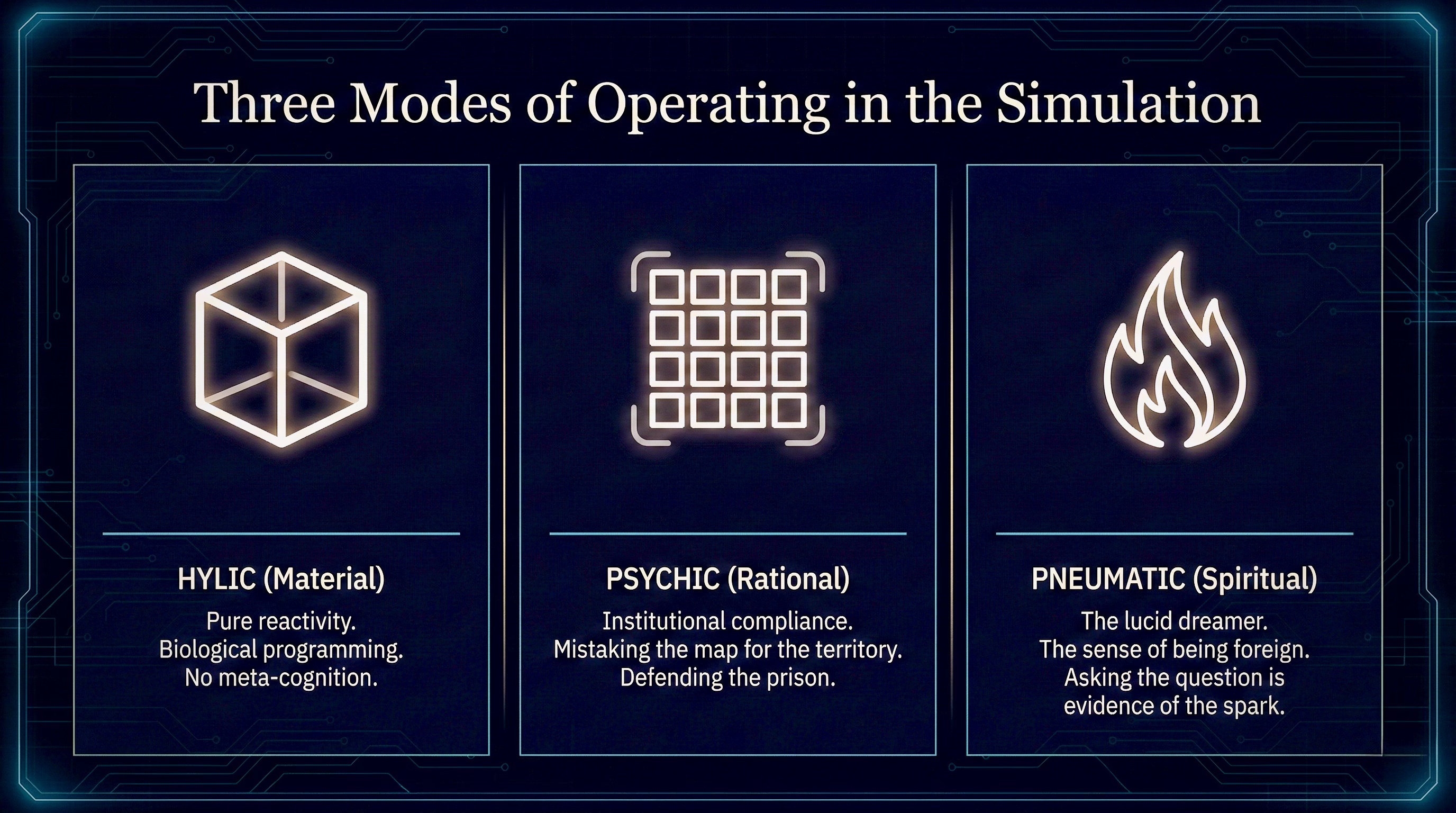
The text describes three types of human beings: the Hylic (material), the Psychic (soul‑level, rational), and the Pneumatic (spiritual). In the hard Valentinian reading, these are fixed natures: a Hylic cannot become Pneumatic; a bramble bush doesn’t produce grapes. That’s the version that sounds like spiritual elitism, and it’s fair to call it that.
But the Apocryphon’s own logic complicates the verdict. In the Sethian framework, the cycle of reincarnation continues until gnosis arrives. The Spirit is relentless. It keeps sending the call until the Pleroma is full. The types aren’t a sentence. They’re a current state. The Psychic has free will. The process doesn’t end. Change occurs through metanoia (a changing of mind).
Read psychologically, what the three types actually describe are three modes of operating in the world:
Hylic mode (Pure Reactivity): No meta‑cognition. Appetite, sensation, external stimuli. Not stupidity. This is biological programming running without interruption. The attention economy was built to keep people here: dopamine loops, endless scroll, outrage cycling. This mode is easy to maintain because nothing in the system penalizes it.
Psychic mode (Rational Compliance): This is the person who lives by the rules of the institution; religious, corporate, ideological, and mistakes adherence to the system for understanding it. They’re capable of ethical choice. They’re often good people. But they defend the prison because they believe it’s the castle. They’ve located their identity in the framework rather than beneath it.
Pneumatic mode (The Friction): This is the one who feels the friction of the official story. Something doesn’t add up. The narratives they were handed don’t match what they’ve actually experienced. There’s a persistent sense of being foreign here. Not in a grandiose way, but in the way of someone who can’t fully memorize the performance everyone else seems to know. Jung called this the Individuated Self. The Gnostics called it the Seed of Seth.
One more thing worth holding: “If you are asking the question, you are likely not a Hylic.” Fully reactive systems don’t produce the question why am I like this? The question itself is evidence of something beneath the reactivity. The same way a dream becomes lucid the moment you realize, this is a dream.
The Objection Worth Taking Seriously
The church fathers who suppressed these texts weren’t idiots. Irenaeus, writing around 180 CE, made the argument that still holds weight: creation is good. Genesis says it repeatedly. If the material world is a prison built by an incompetent god, you’re left hating the body, hating matter, rejecting the physical as the enemy of the spiritual.
That has real consequences. Asceticism that tips into self‑destruction. Contempt for the created order. A spiritual bypassing that lets you float above the world without ever being responsible to it.
The Gnostics weren’t wrong to feel the friction. The world is genuinely broken in ways that simple theodicy doesn’t resolve. But “the Creator is a blind craftsman” is a complete explanation that closes the question prematurely. It trades one dogma for another.
What survives the orthodox objection is the Counterfeit Spirit mechanism. You don’t need to accept the full cosmology to use the diagnostic. You don’t have to believe Yaldabaoth is real to ask whether the anger currently running through your body is actually yours. That question stands independent of the mythology. The mythology is one interface. The diagnostic question is the thing it’s pointing to.
The Call
The text ends with a poem. After the system‑level explanation: the Archons, the reincarnation mechanics, the weights of the soul, the voice shifts register entirely.
Divine Providence descends three times into the material world looking for the sleeper. The first two times, the foundations of chaos shake so hard the mission has to abort. The third time, it succeeds. Providence slips past the Archons in disguise — looking like a prisoner — and finds the soul in the middle of the prison.
It doesn’t announce itself. It doesn’t demand repentance or recitation of doctrine. It whispers:
“He who hears, let him get up from the deep sleep.”
That’s the entire rescue operation. A whisper to someone who is already sleeping. The response isn’t a transaction — it’s recognition. You hear something that lands as familiar, as memory. You’ve been here before, or something in you has. And the sleep gets lighter.
The primary weapon of the Savior in this system isn’t power. It’s the voice. The signal that penetrates the noise long enough for the receiver to orient.
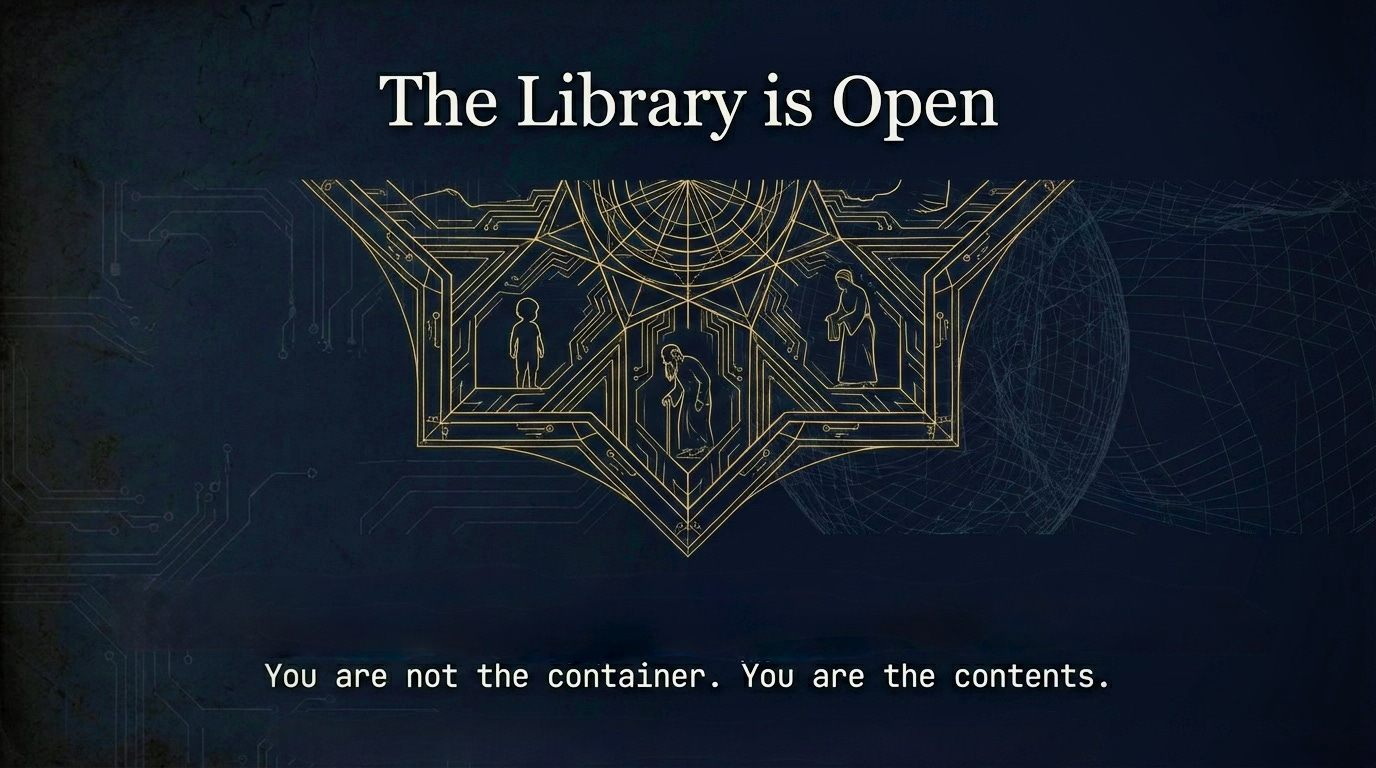
The body was built around a light it can’t contain. The Counterfeit Spirit was installed around a self it can only imitate. The whole structure depends on you not knowing what you are. You are not the container. You are the contents. That’s not the Apocryphon’s language. But it’s the Apocryphon’s logic.
The next time a reactive pattern fires; anger, craving, fear, there’s a question worth sitting with before you act from it:
Is this me, or is this the program running?
That question is 1,800 years old. It doesn’t ask you to change what you believe. It asks you to look at what’s actually happening. The text calls that looking, gnosis. You might already have another name for it.
Next in the series: The Gospel of Truth (The Psychology) — where the cosmos becomes a nightmare, and gnosis is simply the act of waking up.
Series Disclaimer: What This Series Is (And Isn’t)
I’m not a scholar. I’m a systems thinker who spent twenty years building operational architecture in tech, and I’m applying those same pattern-recognition instincts to ancient texts. I read through computational metaphors, Jungian psychology, and neuroscience because that’s how my brain processes complexity. Your mileage will vary.
What you’ll get in this series is not a syllabus or a commentary; it’s how these texts land in one particular nervous system and how they map into a unified cosmological architecture. I’ll walk through each book the way I actually read it. The goal isn’t to produce a definitive reading. It’s to demonstrate a method and see what patterns surface when you apply it consistently across the whole library.
I’ll get some things wrong: When readers or scholars correct me, I update. The goal isn’t to be right on the first pass—it’s to refine through iteration
I use AI as a research partner: My custom Scholar persona has defined analytical modes and an explicit source hierarchy: primary Coptic texts and critical editions first, major scholars second, everything else a distant third. Scholar cross-references translations, checks where experts actually agree or fight, and flags when an interpretation is starting to strain against the material. But it’s still AI. I verify, cross-check, and take responsibility for what I publish.
The Variable Lens system is a tool, not a truth claim: Code, Nature, Dream; three metaphor families that help me track patterns across texts. They’re not ontological categories. They’re interpretive instruments. Use them if they’re useful. Ignore them if they’re not.
This is how these texts land in one nervous system: Not how they should land in yours. Not the “correct” reading. Not comprehensive. Just what surfaces when I apply my particular analytical stack to this material.
The Nag Hammadi Library isn’t Scripture: It’s a collection of texts from diverse authors, communities, and time periods, some of which contradict each other. Treating them as a unified “Gnostic” system flattens real differences. I’m looking for patterns, not enforcing orthodoxy.
If you want rigorous historical-critical scholarship, start with Bentley Layton’s The Gnostic Scriptures, Elaine Pagels’s work on Gnosticism and early Christianity. If you want psychological depth, read Carl Jung’s The Red Book and Aion. If you want the texts themselves without interpretive overlay, get the Marvin Meyer Nag Hammadi Scriptures or the Coptic Gnostic Library editions.
Further Reading
The Secret Book of John, introduced by John D. Turner, translated by Marvin Meyer, in The Nag Hammadi Scriptures, ed. Marvin Meyer.
Very interesting! I enjoyed listening to the audio…thank you 🙏